A junior 3D artist in Johannesburg who can clean messy point clouds, rebuild a broken scan, and turn it into a billable site model will offer more than someone still polishing showroom renders. This matters because the machines collecting that data are getting absurdly small. A new mosquito-like drone from China weighs just 0.3 grams. It can slip into spaces larger drones, body cameras, and human eyes simply cannot reach.
For South African visual tech workers, this is the part to watch. Tiny drones change the kind of visual work that gets paid, not just surveillance. If a device can crawl through a collapsed structure, a mine opening, or a crowded industrial space and bring back usable images, somebody still has to make sense of that material. That somebody is often a 3D artist, a visualiser, or a specialist who can bridge capture, reconstruction, and analysis.
What can a 0.3 gram drone actually do
The headline number should make people stop and look again: 0.3 grams. That is lighter than many coins, and far smaller than the drones most people picture when they hear the word. Engineers have packed wings, sensors, power systems, and control gear into a machine built to behave like an insect, not a flying gadget with a camera bolted on.
This design gives it access to places normal equipment struggles with. Narrow ducts, cluttered rooms, crowded sites, broken structures, and other awkward spaces become fair game. The obvious use is surveillance, because anything that looks like an insect is easy to miss. But the same form factor also makes the drone useful for rescue work, environmental sampling, scientific observation, and inspections in dangerous locations where sending a person is either slow, expensive, or reckless.
The line between science fiction and practical engineering is getting thin. A machine this small can still carry enough function to matter. This should interest 3D artists, because the value is in what happens after the capture, not only in capturing images.
Why 3D skills suddenly matter more
Micro-drones generate awkward visual data. The footage is often noisy, cramped, unevenly lit, and taken from angles nobody planned for. A normal walkthrough video is one thing; a shaky sequence from inside a collapsed stairwell or a tunnel wall is another. To turn that into something usable, teams need people who can reconstruct geometry from incomplete information and present it clearly.
That is where the job shift starts. The useful skills are technical, not only aesthetic.
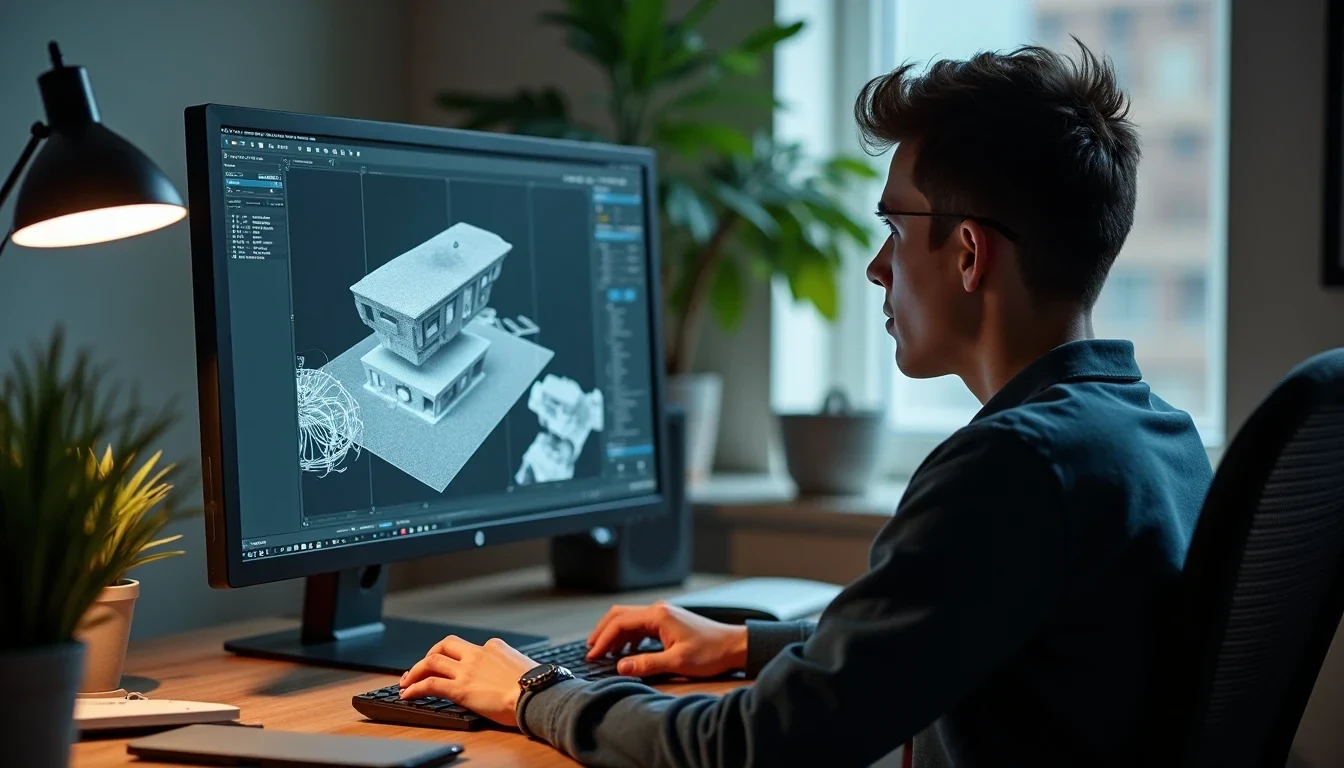
Photogrammetry becomes more valuable when the source material is messy. Point cloud processing becomes essential when scans are dense, incomplete, and full of clutter. Site reconstruction work becomes useful when a mine, warehouse, or damaged structure needs to be measured, inspected, or revisited without sending anyone back in. Unreal Engine or Unity stop being just portfolio tools and start acting as client-facing inspection interfaces. Blender, especially procedural workflows like Geometry Nodes, becomes a way to rebuild structure fast when the raw data is patchy.
A 3D artist who can clean a scan of a corridor, model the missing sections, and give a client a navigable result helps someone make a decision. They are not just making something pretty.
What pays in South Africa
The easiest money will likely come from adjacent work that already exists and is about to get more technical, not from “micro-drone artist” as a job title.
In Cape Town and Johannesburg, there is already demand for 3D generalists who can work across visualisation, simulation, and real-world capture. Add mining, security, infrastructure, and conservation, and the need gets sharper. A freelancer who can produce a clean reconstruction for a site inspection or a navigable facility model can charge more than someone offering static product renders alone.
For early-career work, local freelance rates for solid 3D support can sit anywhere from about R300 to R900 an hour, depending on speed, proof of skill, and whether the work is technical or purely visual. A specialist who understands reconstruction pipelines, can document the process properly, and can deliver something a client can actually use may push well past that. Full-time roles in visualisation, simulation, and technical art often sit in the rough band of R20,000 to R45,000 a month for junior to mid-level work, with stronger numbers in niche industrial or security-adjacent projects.
The market pays for problem solving. A beautiful portfolio still helps, but a portfolio that says, “I turned ugly capture into a usable model,” gets further.
Which South African industries will care first
Mining is the clearest fit. South Africa has deep shafts, unstable faces, tight tunnels, and places that are expensive or risky to inspect by hand. A micro-drone can help map conditions, inspect structural issues, and check ventilation without sending people into the worst spots first. This creates demand for artists who can process scan data from underground environments and build accurate reconstructions.
Conservation is another obvious one. In places like Kruger National Park, covert monitoring can support anti-poaching efforts and wildlife observation without disturbing animals. The data needs to be cleaned, tagged, and turned into something usable by field teams.
Infrastructure inspection will keep growing too. Bridges, pipelines, power systems, and tall buildings all have hidden spaces where problems begin. Micro-drones can reach those areas, but somebody must turn the footage into a usable report or model.
Search and rescue is the most emotionally obvious use. If a building collapses, the first job is finding people. The second is understanding the space well enough to move safely. That is where rapid reconstruction, room mapping, and interactive visualisation matter.
Archaeology and heritage work are less obvious but just as important. South Africa has sites that cannot be handled roughly or repeatedly. Non-invasive 3D documentation is a better fit than physical poking around.
Security is the uncomfortable category. The same tiny drone that helps with inspection can also be used for covert observation. That is exactly why visual specialists need ethical judgement, not just software skills.
What ethics look like when the camera is tiny
A small drone does not make the data harmless. It makes the capture harder to notice. That is the problem.
If you are handling drone data in South Africa, POPIA is not optional background noise. Visual material gathered in private spaces, restricted sites, or sensitive operations has to be treated as legally and ethically serious data. If a client cannot explain where the footage came from, who approved it, and how it is stored, that job is already a risk.
There is also a quality issue that quickly becomes an ethics issue. A 3D artist can make a reconstruction look more certain than it really is. A clean model can hide gaps, distortions, or missing context. In security or inspection work, that can mislead clients. In surveillance work, it can be used to imply more certainty than the source material supports.
If the project involves sensitive capture, ask three direct questions before you touch it. Was the data legally obtained, who can access it, and what exactly is the final use case? If the answers are vague, walk.
How to shape a portfolio for this work
A portfolio aimed at this kind of job should look less like a gallery and more like a case file.
Show one reconstructed environment from rough source material. Then show the cleaned point cloud, the meshed version, and the final render or walkthrough. Add short notes on the software used and the problems you solved. If you used Blender, Unreal Engine, Unity, RealityCapture, or another reconstruction pipeline, say so plainly.
Use South African examples if you can. A mine shaft section, a factory pipe run, a heritage facade, a bridge inspection segment, or a wetland monitoring scene will speak more clearly to local employers than another generic sci-fi corridor. A recruiter in Durban or Johannesburg needs to see that you can work on real problems, not only stylised art tests.
Include one interactive piece if possible. A simple inspection walkthrough, a hotspot overlay, or a data-rich scene in Unreal or Unity shows that you understand the difference between making art and building a tool.
How to check whether training is worth money
A lot of “3D” training still sells glamour instead of employability. That is a waste of time if your goal is income.
Before paying for a course, check for three things. First, does it teach photogrammetry, point cloud cleanup, or site reconstruction workflows, or does it stop at basic modelling? Second, does it show real student work from messy data, not only polished props? Third, does it include software and project briefs that resemble industrial or inspection work?
If a course leans on hype words, vague certificates, or “be earning in weeks” promises, treat it as a sales pitch until it proves otherwise. Ask what jobs its graduates actually land, which South African employers recognise the training, and whether the software stack matches the work being sold. If the answer is dodgy, the course is padding the website, not building income.
The better option is training that can show you a reconstruction pipeline, a data visualisation workflow, and a portfolio outcome that could survive in mining, infrastructure, or security. That is the kind of learning that can get you work on day-rate jobs and support roles, not just another certificate for the folder.
A drone that weighs 0.3 grams does not sound like a big deal until you realise it changes what can be seen, where it can be seen from, and who gets hired to deal with the result. For South African 3D artists, the real opportunity is the flood of awkward visual data that follows it, not the drone itself.